
To be or not to be? That is the unavoidable question. ”We are in the midst of a rupture, not a transition.” With these words, the Canadian Prime Minister, Mark Carney, described the state of the world at last week’s WEF at Davos2026.
This year’s Davos gathering was not just another event but a defining moment. The world has reached an inflection point, facing an unprecedented paradigm shift, and we, Europe, must get our act together. Paradigms do not shift because something better appears, they shift because the old stops working. World orders don’t evolve, they are replaced. In that regard, Carney’s message was spot on: “We are entering a new world order in which middle powers can only benefit by working together. We must act together, because if we’re not at the table, we’re on the menu.”
The question for us, Europe, is no longer whether change is coming, but how we choose to respond to it. Are we going to continue to focus on damage control and “playing not to lose” or are we going to step up our game and start “playing to win”? And let’s get it straight: Europe is much more than a middle power. Right now, Europe is a loose affiliation of middle powers, whereas it has the moral obligation to start behaving as what it is destined for and deserves to be: a superpower. The European Union represents 27 countries, 450 million people, with a combined GDP of more than $20 trillion in nominal terms, putting us in the Top-3 worldwide, together with the US and China. We must capitalize on our scale and size, both internally, by fully leveraging the potential of our own internal market, and externally, by creating coalitions of purpose and power with other economies, being under siege from the US and China too. We, the European Union, have the depth and breadth to be a global game changer and forge a new bond of prosperity with other countries in the geopolitical arena, the UK, Canada, Japan, while enlarging our playing field by developing mutually rewarding trade alliances, ranging from Mercosur to a potential EU-India deal.
Europe must, in the words of Voka urgently make the Switch to growth. That implies growing in confidence and courage, in resolve and relevance, authority and alignment and most importantly in terms of socio-economic return and resilience. To be successful, Europe must move from a “regulation and compliance-first” to a “competitive advantage and added value-first” logic and mindset.
To make the Switch to growth, Europe must embark on a new PACE strategy, by unequivocally and relentlessly focusing on productivity, autonomy, competitiveness and effectiveness.
Productivity growth means deriving maximum benefit from economies of speed, skill and scope, powered by innovation. Autonomy is about strategic independence, sovereignty and security, ranging from energy and industry to technology and infrastructure.
Competitiveness is about reducing the labor cost, energy and system handicaps, removing the barriers for an optimally functional internal market and creating synergies through plurilateral partnerships and alliances.
Effectiveness in terms of governance and policy is first and foremost about reduced complexity and faster decision making, better alignment and priority setting, less fragmentation and more unity.
Setting a new PACE to make the Switch to growth, that must be the game plan to make Europe future-proof. That endeavor also applies to Belgium and Flanders. In a new Europe, smaller powers like the Benelux and Scandinavia must seize the moment to lead by example and act as catalysts for growth. This is not only a political duty, but also the responsibility of all of us, business leaders and entrepreneurs!
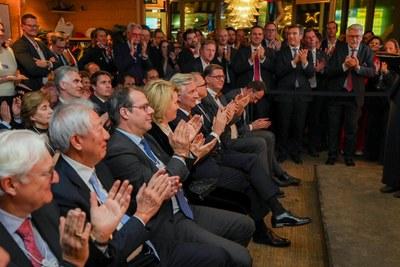
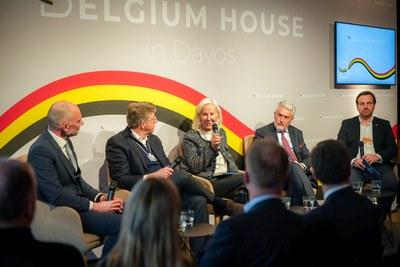
That was our Voka message at Davos. Together with Frank Beckx, I had the chance to join the CompassforEuropeSummit and enjoy the many insightful conversations and activities in and around the BelgianHouse with leading CEO’s, Matthias Diependaele, Bart De Wever. In particular, it was a pleasure to contribute to the panel discussion on “Switzerland through the Belgian mirror”. Many thanks to Olivier van Horenbeeck and Peter Vanham from AtlasHouse and to my fellow panelists Stefaan Fiers, Tycho Sneyers and Iris Maria Alexis Van der Veken.